
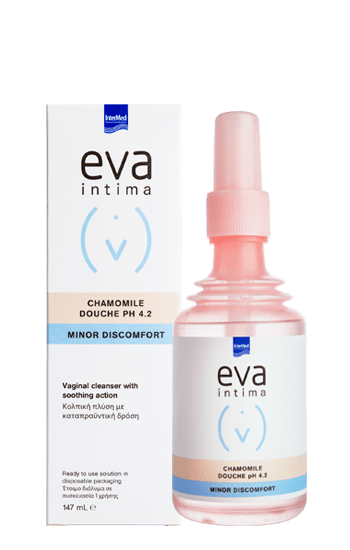


EVA INTIMA® CHAMOMILE DOUCHE pH 4.2 with chamomile extract, is designed to remove accumulated secretions and at the same time to offer immediate and effective relief of the vaginal mucosa from the symptoms of burning itching and irritation that may or may not accompany a vaginal infection.
Its composition is enriched with lactic acid to enhance the acidic balance of the vagina.

It gently cleanses the vaginal mucosa with zero risk of pushing pathogenic microorganisms, discharge, or foreign bodies toward the cervix and uterus.
The specially designed nozzle of the device and the squeezable transparent bottle ensure easy, atraumatic application.
It contains no medicinal substances, hormones, synthetic colors, or fragrances.
The wash can be done either while sitting on the toilet or in the bathroom, either seated or standing.
Vaginitis is characterized as inflammation of the vaginal mucosa, that is, the membrane that covers the inner surface of the vagina.
The main symptoms of vaginitis regardless of its cause are the presence of itching, irritation, burning and excessive discharge of different texture, odor and color from the normal ones. Often there can be pain during sexual contact and urination.
The most common causes of vaginitis are bacteria and fungi while it can often be caused by the lack of estrogen or by allergy (for example from the use of condoms or other vaginal products). However, cases are not rare where there may be signs of inflammation without finding any specific cause. These cases are characterized as non-specific vaginitis and are usually attributed to hormonal imbalance (frequent during pregnancy).
Bacterial vaginitis is the most frequently occurring vaginitis. The symptoms that usually predominate are itching, irritation, burning and the appearance of excessive thin discharge with a strong fishy odor that can intensify after sexual contact or menstruation, grayish in color.
However, particular attention is required as there are sexually transmitted diseases caused by bacteria such as vaginal infection from trichomoniasis.
In any case, proper and safe diagnosis and treatment is achieved only through a gynecologist following a series of diagnostic tests (colposcopy, vaginal fluid culture, etc.), a practice that is recommended to follow every time you notice changes in the broader area.
Depending on the symptoms that concern you there are product options that can relieve you. However, complete relief from the cause of inflammation cannot be achieved unless diagnosis has been made and appropriate treatment has been given by your gynecologist.
In case of bacterial etiology vaginitis you can combine (diagram for bacterial vaginitis)
In case of fungal etiology vaginitis you can combine (diagram for fungal vaginitis)
In case of non-specific etiology vaginitis you can combine (diagram for atypical vaginitis)
The appearance of vaginitis can be prevented if the natural flora of the area is maintained with the predominance of lactobacilli, the acidic environment of the vagina (pH 3.5-4.5) with the presence of lactic acid and the necessary moisture for the tissues. The assurance of these factors prevents the development of infections. In case these are disrupted, appropriate product options such as probiotics, vaginal pH regulators and hydration products can help restore and maintain these and prevent the appearance of infections.
PREVENTION OF VAGINITIS AFTER MENSTRUATION
Tips:
Although fungi are natural inhabitants of the vagina they very often lead to infections while there are specific reasons that reduce the probability of successful control of these and relief from the manifestations of vaginitis. As a result, reappearance of symptoms of fungal vaginitis is often recorded very soon after the previous episode of it, a fact that is characterized as recurrence. Main causes are the development of resistance to common drug treatments, inadequate diagnosis, self-diagnosis, non-compliance with treatment regimens, etc.
In any case, proper and safe diagnosis and treatment is achieved only through a gynecologist following a series of diagnostic tests (colposcopy, vaginal fluid culture, identification of responsible strains, selection of effective active agents each time, etc.), a practice that is recommended to follow every time you notice changes in the broader area.
Careful adherence to treatment regimens and the adoption of practices that directly strengthen the local balance and defense of the area are the means for successful prevention of recurrences.
PREVENTION OF VAGINITIS AFTER MENSTRUATION
Tips:
Rinsing and cleansing of the vaginal mucosa through special devices can be done every time you need to get rid of bothersome discharge and odors, to relieve symptoms such as itching and burning sensation or you wish to enhance the feeling of comfort and refreshment of the area.
The application of vaginal douches is beneficial (when usage conditions are observed) as they strengthen and accelerate the vagina’s self-cleansing ability, relieving it from remnants of menstruation, excessive normal or pathological discharge while at the same time relieving from irritations such as itching, irritation, burning or unpleasant odors.
When their application precedes the application of other vaginal formulations they maximize the effectiveness of their action contributing substantially to successful therapeutic management of pathological conditions.
The intravaginal application of homemade solutions is better to be avoided mainly due to the unstable composition content as well as the non-specific devices that are usually used, which promote trauma, the transfer of pathogenic microorganisms to the cervix and uterus and the possibility of reinfection.
Similarly, when there is no specific etiology, strong antiseptic agents should be avoided which negatively affect the natural flora as well as the integrity of the vaginal mucosa.
The frequency of application of vaginal douches depends on the etiology of their use. Under normal conditions where the application of vaginal douche aims at maintaining the hygiene and comfort of the area, repetition of application is recommended not more frequently than every 3 days. When there are specific reasons such as removal of menstruation, white discharge or relief of irritation, the application can be repeated once daily for 2 to consecutive 3 days or according to the recommendation of the treating physician.
Vaginal douches should be performed under conditions where maximum hygiene is maintained so as not to increase the probability of disruption of vaginal balance, a fact that can lead to serious infections. Especially in cases where rinsing of the vagina is performed to relieve symptoms of some vaginitis, repeated use of the same device can lead to reinfection due to contamination of the device or the solution.
Vaginal douches are not recommended in cases where there have been no complete sexual relations or during pregnancy. An exception is when there is a recommendation from the treating gynecologist.
Lactic acid is the factor that shapes the acidic environment in the vagina.
During reproductive age it is released by the lactobacilli of the normal vaginal flora after metabolism of glycogen that they use as food. The acidic vaginal environment is favorable and enhances the action of lactobacilli while at the same time restricts the development of other pathogenic microorganisms. However, even beyond reproductive age such as during post-menopause, maintaining acidic conditions in the vagina can be a means for preventing the manifestation of infections. At this stage of a woman’s life, vaginal pH regulators that offer ready-made lactic acid and directly shape the required acidity in the vagina can help directly.
Itching, irritation and burning sensation are clinical manifestations that can be observed in conditions of different etiology in the vaginal area. They are usually observed in cases of infection of various etiologies where they coexist simultaneously with increased vaginal discharge with or without odor. The presence of these symptoms without the presence of excessive discharge can be due to the manifestation of vaginal dryness.
In any case, proper and safe diagnosis and treatment is achieved only through a gynecologist following a series of diagnostic tests (colposcopy, vaginal fluid culture, etc.), a practice that is recommended to follow every time you notice changes in the broader area.