
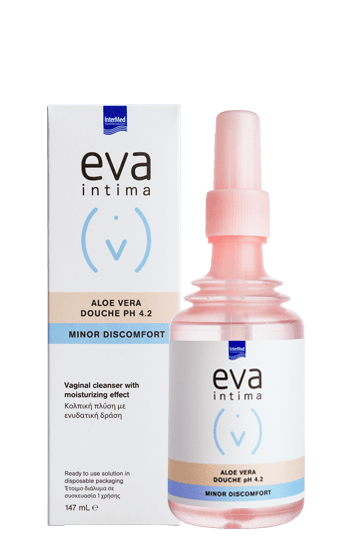


EVA INTIMA® ALOE VERA DOUCHE pH 4.2 with aloe extract, is designed to remove any accumulated hyper-secretions and residues of other vaginal products (e.g. moisturizing or lubricating gels), while providing hydration. Its composition is enriched with lactic acid to enhance the acidic balance of the vagina.

Gently cleanses the vaginal mucosa with zero risk of pushing pathogenic microorganisms, secretions or foreign bodies towards the cervix and uterus.
The specially designed applicator nozzle and the soft, transparent squeezable bottle ensure easy and atraumatic application.
Does not contain pharmaceutical substances, hormones, synthetic colorants or fragrances.
Use 1 to 2 vaginal douches per week for a feeling of cleanliness and hydration.
The douche can be performed either while sitting on the toilet or in the shower/bathroom (sitting or standing).
Vaginal rinsing and cleansing using specially designed douche devices can be performed whenever you need to eliminate bothersome discharge and odors, relieve symptoms such as itching and burning, or enhance the feeling of comfort and freshness in the intimate area.
When used according to the recommended guidelines, vaginal douching can be beneficial as it supports and enhances the vagina’s natural self-cleansing ability. It helps remove menstrual blood residues, excessive physiological or pathological discharge, while also relieving discomforts such as itching, irritation, burning sensations and unpleasant odors.
When used prior to the application of other intravaginal products, vaginal douching maximizes their effectiveness, thereby contributing significantly to the successful therapeutic management of pathological conditions.
The intravaginal use of homemade solutions is best avoided, mainly due to the inconsistent composition of such preparations and the non-specialized devices typically used for their application. These may increase the risk of injury, promote the transfer of pathogenic microorganisms to the cervix and uterus, and increase the likelihood of reinfection.
Likewise, in the absence of a specific underlying cause, the use of strong antiseptic agents should be avoided, as they may negatively affect the natural vaginal flora as well as the integrity of the vaginal mucosa.
The frequency of vaginal douche use depends on the reason for its application.
Under normal conditions, when the vaginal douche is used to maintain intimate hygiene and comfort, it is recommended not to be used more frequently than once every 3 days.
When there are specific reasons for use, such as the removal of menstrual residue, vaginal discharge, or the relief of irritation, the douche may be used once daily for 2 to 3 consecutive days, or according to the recommendation of the attending physician.
Vaginal douching should be performed under conditions of maximum hygiene to avoid increasing the risk of disrupting the vaginal balance, which may lead to serious infections. In particular, when vaginal irrigation is used to relieve the symptoms of vaginitis, repeated use of the same device may result in reinfection due to contamination of the device or the solution.
Vaginal douching is not recommended in cases where there has been no complete sexual intercourse or during pregnancy. Exceptions may apply when its use has been specifically recommended by the attending gynecologist.
Lactic acid is the factor responsible for maintaining the acidic environment of the vagina.
During the reproductive years, lactic acid is produced by lactobacilli, which are part of the normal vaginal flora, after metabolizing glycogen that they use as a source of nutrition. An acidic vaginal environment supports and enhances the activity of lactobacilli while simultaneously inhibiting the growth of other pathogenic microorganisms.
However, even beyond the reproductive years, such as during menopause, maintaining acidic conditions in the vagina may help prevent the development of infections. At this stage of a woman’s life, vaginal pH regulators can provide direct support by supplying ready-to-use lactic acid and rapidly establishing the required acidity in the vagina.
Itching, irritation, and a burning sensation are clinical symptoms that may occur in the vaginal area due to a variety of causes. They are most commonly associated with infections of different origins and are often accompanied by increased vaginal discharge, with or without odor. When these symptoms occur in the absence of excessive vaginal discharge, they may be indicative of vaginal dryness.
In all cases, accurate and safe diagnosis and treatment can only be provided by a gynecologist following a series of diagnostic procedures (such as colposcopy, vaginal fluid culture, and others). This approach is recommended whenever you notice any changes in the vaginal area or surrounding intimate region.