
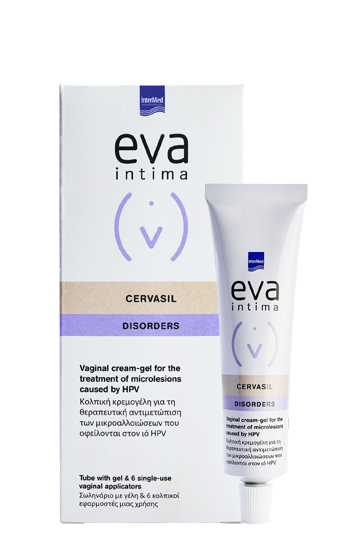


Eva Intima Cervasil cream-gel is a specially designed vaginal cream gel for the management of cervical lesions due to HPV.
Its composition is based on bioactive ingredients of plant origin, for the effective management of HPV infection, with the highest safety and better tolerance.
With curcumin well known for its immunomodulatory & anticancer action, antiviral agent docosanol, anaplastic aloe and amla extracts, prebiotic agents such as CM-β-glucans & lactic acid, Eva Intima Cervasil cream-gel helps strengthen local defenses, heals epithelial microlesions and restores normal conditions in the vagina.
Packaging with tube with cream-gel & 6 disposable vaginal applicators

Eva Intima Cervasil cream-gel contributes to:
1st week: 1 vaginal application x 6 consecutive days.
Following 3-6 months: 1 vaginal application x 2 days per week.
1st week: 1 vaginal application x 6 consecutive days.
Following 3-6 months: 1 vaginal application x 2 days per week.
2 applications x 6 consecutive days (topically, without applicator).
Preferably the application should be done before sleep, and outside menstruation days.
Due to the natural dye of curcumin it is recommended to use a sanitary pad to avoid staining underwear.
Vaginitis is characterized as inflammation of the vaginal mucosa, that is, the membrane that covers the inner surface of the vagina.
The main symptoms of vaginitis regardless of its cause are the presence of itching, irritation, burning and excessive discharge of different texture, odor and color from the normal ones. Often there can be pain during sexual contact and urination.
The most common causes of vaginitis are bacteria and fungi while it can often be caused by the lack of estrogen or by allergy (for example from the use of condoms or other vaginal products). However, cases are not rare where there may be signs of inflammation without finding any specific cause. These cases are characterized as non-specific vaginitis and are usually attributed to hormonal imbalance (frequent during pregnancy).
Bacterial vaginitis is the most frequently occurring vaginitis. The symptoms that usually predominate are itching, irritation, burning and the appearance of excessive thin discharge with a strong fishy odor that can intensify after sexual contact or menstruation, grayish in color.
However, particular attention is required as there are sexually transmitted diseases caused by bacteria such as vaginal infection from trichomoniasis.
In any case, proper and safe diagnosis and treatment is achieved only through a gynecologist following a series of diagnostic tests (colposcopy, vaginal fluid culture, etc.), a practice that is recommended to follow every time you notice changes in the broader area.
Vulvovaginitis caused by fungi is the second most commonly occurring vaginitis. It is not a sexually transmitted disease and does not “spread” as fungi are part of the normal vaginal flora, where they naturally remain in low populations. Common causes of their overgrowth that can lead to the manifestation of vaginitis are conditions that lead to a reduction in lactobacilli in the vagina and the predominance of other microorganisms in the area (e.g. after taking antibiotics for any reason, use of unsuitable and strong vaginal antiseptic solutions, etc).
The symptoms that most commonly occur include intense itching, irritation, a burning sensation, and excessive vaginal discharge that is thick in consistency and white in color, commonly referred to as leukorrhea, without the presence of any characteristic unpleasant odor.
In any case, proper and safe diagnosis and treatment is achieved only through a gynecologist following a series of diagnostic tests (colposcopy, vaginal fluid culture, etc.), a practice that is recommended to follow every time you notice changes in the broader area.
Depending on the symptoms that concern you there are product options that can relieve you. However, complete relief from the cause of inflammation cannot be achieved unless diagnosis has been made and appropriate treatment has been given by your gynecologist.
In case of bacterial etiology vaginitis you can combine (diagram for bacterial vaginitis)
In case of fungal etiology vaginitis you can combine (diagram for fungal vaginitis)
In case of non-specific etiology vaginitis you can combine (diagram for atypical vaginitis)
The appearance of vaginitis can be prevented if the natural flora of the area is maintained with the predominance of lactobacilli, the acidic environment of the vagina (pH 3.5-4.5) with the presence of lactic acid and the necessary moisture for the tissues. The assurance of these factors prevents the development of infections. In case these are disrupted, appropriate product options such as probiotics, vaginal pH regulators and hydration products can help restore and maintain these and prevent the appearance of infections.
PREVENTION OF VAGINITIS AFTER MENSTRUATION
Tips:
The transition to reproductive age is marked by the periodic appearance of bleeding that lasts for a few days and usually occurs every 24 to 28 days. The presence of blood in the vaginal area – although physiological – can lead to minor disturbances in the vaginal environment affecting vaginal pH and the presence of lactobacilli as blood carries a neutral pH value. This effect combined with the fact that blood is a favorable nutritional substrate for fungi that naturally exist in the vagina, often lead to the organism’s inability to control fungal overgrowth which ultimately causes inflammation in the area.
Strengthening the natural mechanism of removing blood residues and the immediate restoration of vaginal pH to its natural acidic values can limit the appearance of vaginitis after the end of the period.
Indicatively you can combine (diagram for prevention of vaginitis and strengthening of natural balance after the period)
Tips:
You can adopt daily intake of probiotics by mouth through special supplements with lactobacilli so that you easily and naturally strengthen the flora of the vagina
Although fungi are natural inhabitants of the vagina they very often lead to infections while there are specific reasons that reduce the probability of successful control of these and relief from the manifestations of vaginitis. As a result, reappearance of symptoms of fungal vaginitis is often recorded very soon after the previous episode of it, a fact that is characterized as recurrence. Main causes are the development of resistance to common drug treatments, inadequate diagnosis, self-diagnosis, non-compliance with treatment regimens, etc.
In any case, proper and safe diagnosis and treatment is achieved only through a gynecologist following a series of diagnostic tests (colposcopy, vaginal fluid culture, identification of responsible strains, selection of effective active agents each time, etc.), a practice that is recommended to follow every time you notice changes in the broader area.
Careful adherence to treatment regimens and the adoption of practices that directly strengthen the local balance and defense of the area are the means for successful prevention of recurrences.
PREVENTION OF VAGINITIS AFTER MENSTRUATION
Tips:
Probiotics are living microorganisms which do not cause disease in the human body and contribute in many ways to ensuring its health, e.g. by preventing the growth of other pathogenic microorganisms, contributing to the digestion of foods, etc.
Naturally, in most cavities of the human body as well as on the skin, there is flora, that is microorganisms that over the years have managed to coexist harmoniously with humans and develop a mutually beneficial relationship with them (the microorganisms find favorable ground to survive and at the same time strengthen the first line of defense of the human body). In the event that there is a disruption of the normal flora, e.g. from the intake of antibiotic preparations, it is then easy for pathogenic microorganisms to develop and cause infections. The quicker restoration of normal flora with the use of probiotic preparations contributes to the effective control of pathogenic microorganisms and the prevention of the development of new ones.
The normal flora that may colonize different cavities of the body differs significantly from point to point, depending on the person’s age, dietary habits, lifestyle, etc. For the vaginal cavity, the microorganisms that have dominated over the years and contribute significantly to maintaining the balance of the area are lactobacilli. This type of bacteria needs to dominate each time, especially during the reproductive age of the woman, to maintain the acidic environment in the area. In case the population of lactobacilli is disrupted, the probability of pathological conditions increases. Probiotic preparations that act effectively by restoring and recovering the vaginal flora are those that contain in their composition a large amount of lactobacilli – the type of bacteria that naturally dominate the vagina and create the desired acidic environment and pH of vaginal fluid.
There are bacterial strains used as probiotics which by their nature have the ability depending on the conditions that prevail to take two forms:
-the spore form, a resistant form that preserves the microorganism when environmental conditions threaten its viability,
-the vegetative form, which gives the microorganism the ability to develop and multiply when conditions are favorable.
Choosing probiotic preparations that offer their bacterial strains in spore form ensures that the microorganism reaches the desired target tissue alive despite all the processing it has undergone during the stages of production, packaging, storage and transport. Thus the maximum effectiveness of their use is achieved.
As eva intima biolact ovules contains populations of living lactobacilli in spore form, there may be small variations in the color of the suppository (from off-white to light gray-beige), a fact which is considered normal since it depends on the culture media that were used each time for the development of these bacteria.
The application of vaginal suppositories is beneficial regardless of how often you choose to perform it without any limit on the frequency of use. However, when the question of restoring the flora after infections arises, at least 8 days are required for a strong and intact population of lactobacilli to be reformed in the area.
Lactic acid is the factor that shapes the acidic environment in the vagina.
During reproductive age it is released by the lactobacilli of the normal vaginal flora after metabolism of glycogen that they use as food. The acidic vaginal environment is favorable and enhances the action of lactobacilli while at the same time restricts the development of other pathogenic microorganisms. However, even beyond reproductive age such as during post-menopause, maintaining acidic conditions in the vagina can be a means for preventing the manifestation of infections. At this stage of a woman’s life, vaginal pH regulators that offer ready-made lactic acid and directly shape the required acidity in the vagina can help directly.
Itching, irritation and burning sensation are clinical manifestations that can be observed in conditions of different etiology in the vaginal area. They are usually observed in cases of infection of various etiologies where they coexist simultaneously with increased vaginal discharge with or without odor. The presence of these symptoms without the presence of excessive discharge can be due to the manifestation of vaginal dryness.
In any case, proper and safe diagnosis and treatment is achieved only through a gynecologist following a series of diagnostic tests (colposcopy, vaginal fluid culture, etc.), a practice that is recommended to follow every time you notice changes in the broader area.